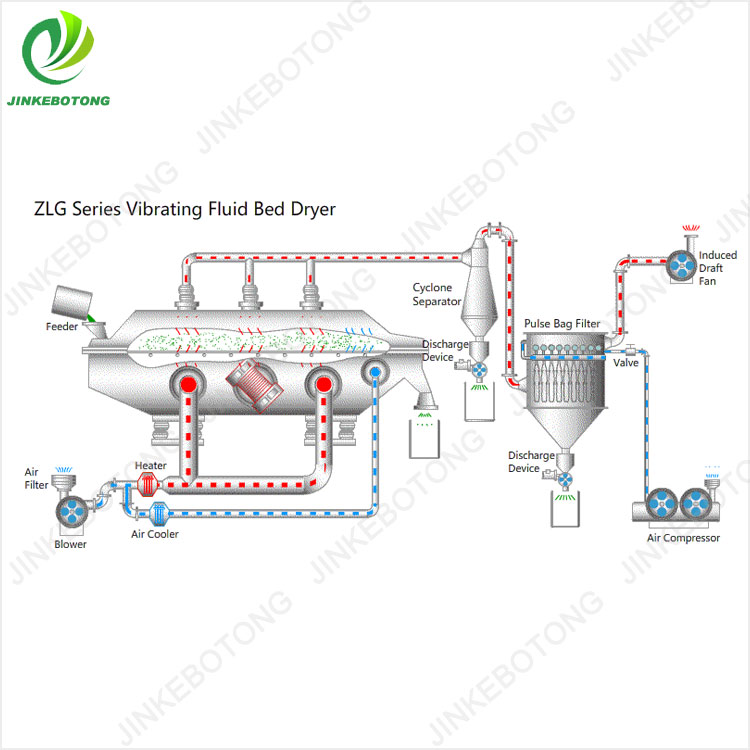
Advantages of vibrating fluidized bed dryers
2026,01,09
(1) In a conventional fluidized bed, material fluidization is achieved entirely by airflow, while in a vibrating fluidized bed, fluidization and conveying are primarily accomplished by vibration. Under the combined action of excitation force and hot air with a certain pressure, the material exhibits an ideal fluidization state, ensuring sufficient contact between the material and the hot air.
(2) The addition of vibration reduces the
minimum fluidization velocity of the material, causing fluidization to occur earlier, especially in the particles near the bottom of the gas distribution plate, which helps eliminate wall phenomena and improves fluidization quality.
(3) The hot air entering the dryer is mainly used for heat and mass transfer during the drying process. Higher inlet air temperature and increased material layer thickness result in higher thermal efficiency. The thermal efficiency of a typical vibrating fluidized bed dryer is between 30% and 60%. Therefore, the air volume is significantly reduced, only 20% to 30% of that in a conventional fluidized bed dryer. The load on the fine powder recovery system is reduced, and fine powder entrainment is generally decreased. The specifications of the supporting heat source, fan, cyclone separator, etc., are also reduced accordingly, resulting in significant energy savings.
(4) Vibrating fluidized beds can dry materials with a wide particle size distribution and relatively uniform residence time; they can also dry viscous or thermoplastic materials, reducing the requirements for material uniformity and regularity, and easily obtaining uniform dried products.
(5) The improved bed structure increases the heat transfer coefficient and phase interface area, and also increases the turbulence of the boundary layer, thus strengthening the drying process.