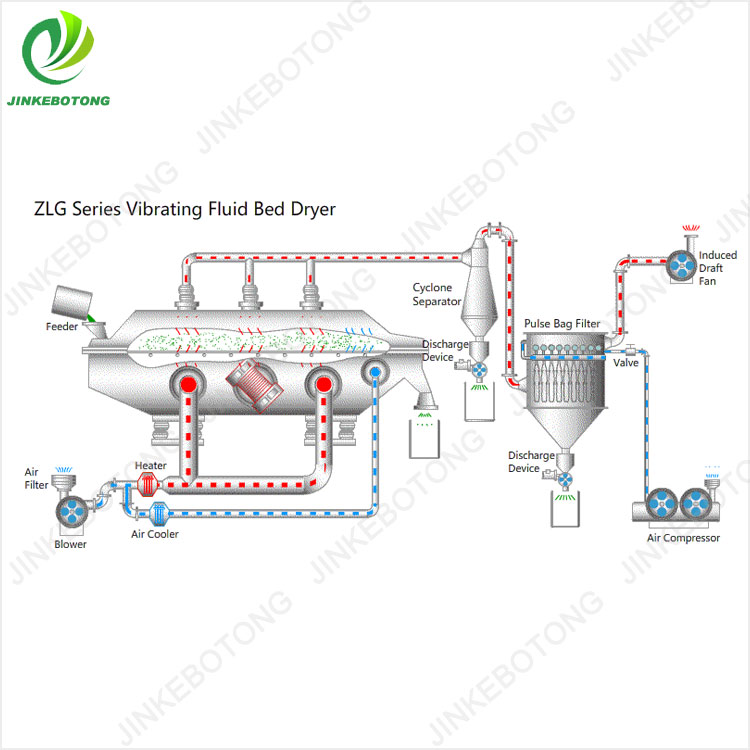
Fluid Bed Dryer: Advanced Drying Technology for Industrial Applications The fluid bed dryer is a highly efficient and versatile drying system designed to remove moisture from various materials using a combination of heat and air flow. This advanced drying method ensures uniform drying, minimal product degradation, and high energy efficiency, making it an ideal choice for industries that require precise and reliable drying processes. Whether used in pharmaceuticals, food processing, chemical manufacturing, or other industrial sectors, the fluid bed drying method offers a robust solution for achieving optimal drying outcomes. Key Features of the Fluid Bed Dryer This fluid bed dryer is engineered with precision and durability in mind. Its design allows for continuous operation, ensuring consistent performance throughout the drying process.
The unit features a controlled airflow system that evenly distributes heat across the material, promoting rapid and even moisture removal. Additionally, the fluid bed dryer is equipped with adjustable parameters such as temperature, air velocity, and residence time, enabling customization to suit different materials and production requirements. The use of high-quality materials ensures long-term reliability and minimal maintenance, making it a cost-effective investment for any industrial setting. Detailed Description of the
Fluid Bed Dryer The fluid bed drying method involves suspending particles in a stream of heated air, creating a fluid-like state that enhances heat transfer and evaporation. As the material moves through the drying chamber, the hot air interacts with the particles, effectively removing moisture while maintaining product integrity. This technique is particularly beneficial for fragile or heat-sensitive materials, as it minimizes direct contact and reduces the risk of damage. The fluid bed dryer can be configured with multiple zones, allowing for staged drying processes that further improve efficiency and quality control. The system is also compatible with various feed types, including powders, granules, and flakes, making it adaptable to a wide range of applications.
Applications and Use Cases The fluid bed dryer is widely used in numerous industries where effective moisture removal is essential. In the pharmaceutical industry, it is employed to dry active pharmaceutical ingredients (APIs) and excipients, ensuring uniform particle size and enhanced solubility. In food processing, the fluid bed drying method is utilized to dehydrate fruits, vegetables, and other food products while preserving flavor and nutritional content. Chemical manufacturers rely on this technology to dry catalysts, resins, and other compounds, maintaining their reactivity and purity. Additionally, the fluid bed dryer is suitable for use in the production of coatings, adhesives, and other specialty materials, offering a reliable and scalable drying solution. User Reviews and Feedback Users of the fluid bed dryer consistently praise its performance, efficiency, and ease of integration into existing production lines. Many highlight the system's ability to maintain product quality while significantly reducing drying time compared to traditional methods.
One user noted that the fluid bed drying method improved their overall production output by allowing faster turnaround times without compromising on product consistency. Another user emphasized the flexibility of the system, stating that the ability to adjust parameters made it suitable for a variety of materials and applications. Overall, the feedback underscores the value of the fluid bed dryer as a dependable and high-performing drying solution. Frequently Asked Questions What are the advantages of using a fluid bed dryer? The fluid bed dryer offers several benefits, including efficient heat transfer, uniform drying, minimal product degradation, and the ability to handle a wide range of materials. It also provides energy savings and reduces drying time compared to conventional methods. Can the fluid bed dryer be customized for specific applications? Yes, the fluid bed dryer can be tailored to meet specific industrial needs.
Parameters such as temperature, airflow, and drying time can be adjusted to accommodate different materials and production requirements. Is the fluid bed drying method suitable for heat-sensitive materials? Yes, the fluid bed drying method is well-suited for heat-sensitive materials due to its ability to provide gentle and even drying without causing structural damage. How does the fluid bed dryer compare to other drying technologies? Compared to other drying methods such as tray drying or spray drying, the fluid bed dryer offers superior efficiency, uniformity, and scalability. It also reduces the risk of product contamination and ensures consistent quality. What maintenance is required for a fluid bed dryer? Regular maintenance includes cleaning the drying chamber, checking airflow systems, and inspecting components for wear and tear. Proper maintenance ensures optimal performance and extends the lifespan of the equipment.


 Contact Now
 Jinkebotong Environmental Protection Technology (Jiangsu) Co., Ltd