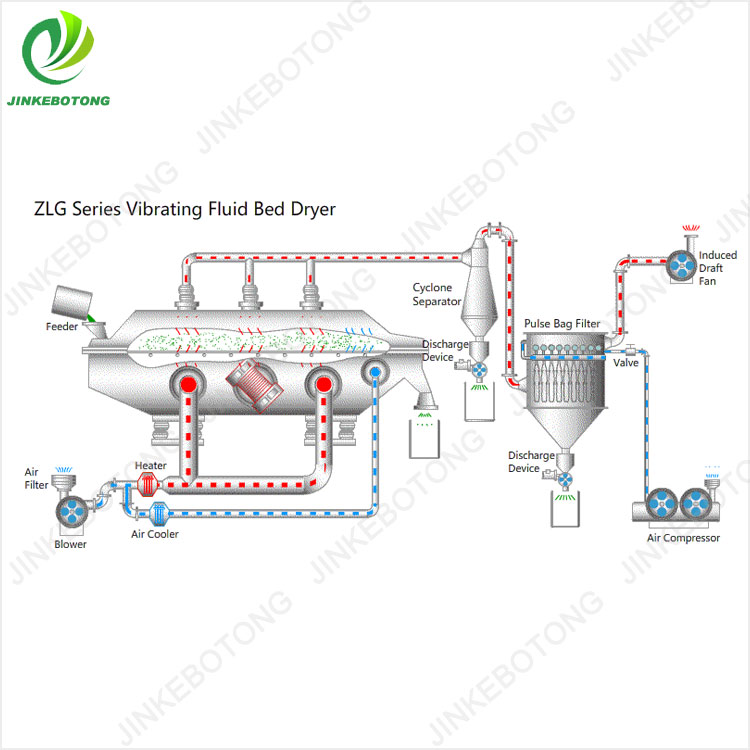
Fluid Bed Dryer: Continuous Fluid Bed Dryer for Efficient and Uniform Drying Processes The continuous fluid bed dryer is a state-of-the-art drying system designed to provide rapid, uniform, and energy-efficient drying of various materials. This advanced equipment utilizes the principle of fluidization, where fine particles are suspended in a stream of hot air, creating a dynamic and highly efficient drying environment. The continuous operation of this dryer ensures uninterrupted processing, making it ideal for industrial applications that require high throughput and consistent product quality. Key Features of the Continuous Fluid Bed Dryer This fluid bed dryer is engineered with several key features that enhance its performance and reliability. One of the most notable aspects is its ability to maintain precise temperature control throughout the drying process, ensuring that sensitive materials are not damaged. The system also includes a modular design, allowing for easy integration into existing production lines or customization for specific application requirements.
Additionally, the dryer is equipped with an advanced air distribution system that promotes even particle suspension and maximizes heat transfer efficiency. The use of high-quality materials ensures durability and resistance to corrosion, extending the lifespan of the equipment. Detailed Description of the
Continuous Fluid Bed Dryer The continuous fluid bed dryer operates by introducing a controlled flow of heated air through a perforated plate, which causes the material to behave like a fluid. This fluid-like movement allows for optimal contact between the material and the drying medium, significantly increasing the rate of moisture removal. Unlike traditional drying methods that may result in uneven drying or thermal degradation, this system ensures a uniform drying profile across the entire batch. The continuous nature of the dryer means that there is no need for frequent shutdowns or manual intervention, leading to improved productivity and reduced labor costs. The system can be customized with various configurations, including different types of heating elements, control systems, and
Material Handling components. It is suitable for both powder and granular materials, making it a versatile solution for industries such as pharmaceuticals, food processing, chemical manufacturing, and more.
The dryer's design also allows for easy cleaning and maintenance, reducing downtime and ensuring compliance with hygiene and safety standards. Applications and Use Cases The continuous fluid bed dryer is widely used in multiple industries due to its versatility and efficiency. In the pharmaceutical sector, it is employed for drying tablets, powders, and granules, ensuring that the final product meets strict quality and consistency standards. In the food industry, it is used to dry ingredients such as spices, dairy products, and cereals, preserving their nutritional value and flavor. Chemical manufacturers rely on this dryer for processing catalysts, fertilizers, and other specialty chemicals that require precise moisture control. Additionally, the continuous fluid bed dryer is commonly used in the production of coatings, adhesives, and polymers, where maintaining the integrity of the material during the drying process is critical. Its ability to handle large volumes without compromising quality makes it an essential component in modern industrial production facilities.
Whether used for small-scale operations or large-scale manufacturing, this dryer offers a reliable and cost-effective solution for a wide range of drying needs. User Reviews and Feedback Users of the continuous fluid bed dryer have consistently praised its performance and efficiency. Many have noted that the system provides faster drying times compared to conventional methods, resulting in higher production output. The ease of operation and maintenance has also been highlighted as a major advantage, with many operators reporting minimal training required to manage the system effectively. One user from the food industry mentioned that the dryer helped them achieve better product consistency and reduce waste due to over-drying. Another user in the chemical sector appreciated the system’s ability to handle different types of materials without requiring significant modifications. Overall, the feedback indicates that the continuous fluid bed dryer is a valuable investment for businesses looking to improve their drying processes and meet industry demands.
Frequently Asked Questions What is a continuous fluid bed dryer? A continuous fluid bed dryer is a type of drying equipment that uses a fluidized bed to suspend and dry materials continuously. This system is designed to provide efficient and uniform drying while maintaining high throughput. How does a fluid bed dryer work? In a fluid bed dryer, a stream of hot air is passed through a bed of particles, causing them to behave like a fluid. This process enhances heat transfer and moisture removal, ensuring that the material is dried evenly and efficiently. What are the advantages of using a continuous fluid bed dryer? The advantages include faster drying times, uniform drying, energy efficiency, and the ability to handle large volumes without interruption. It also offers flexibility in processing different types of materials and can be integrated into existing production lines. Is the continuous fluid bed dryer suitable for all types of materials? While it is highly versatile, the suitability depends on the material's physical properties, such as particle size, moisture content, and sensitivity to heat. Customization options allow for adaptation to different applications. Can the dryer be integrated into existing production systems? Yes, the continuous fluid bed dryer is designed with modular components that make it compatible with various production setups. It can be easily adapted to fit the specific needs of different industries. What maintenance is required for a fluid bed dryer? Regular maintenance includes cleaning the air distribution system, inspecting heating elements, and checking the control systems for proper function. Following the manufacturer’s guidelines ensures optimal performance and longevity of the equipment.


 Contact Now
 Jinkebotong Environmental Protection Technology (Jiangsu) Co., Ltd